From the archives: I wrote this piece in 2021 and submitted it to a literary competition (it wasn’t selected). I’ve held this writing close but have decided to share it now.
It is a late Sunday afternoon in mid-October. I’ve been called downstairs by the scent of a roast slowly simmering, drawn by the comforting smell of family dinner. This house has cold spots, with long, dark overhangs and I am craving warmth. As I make my way down the stairs, I hear the faint sound of opera playing.
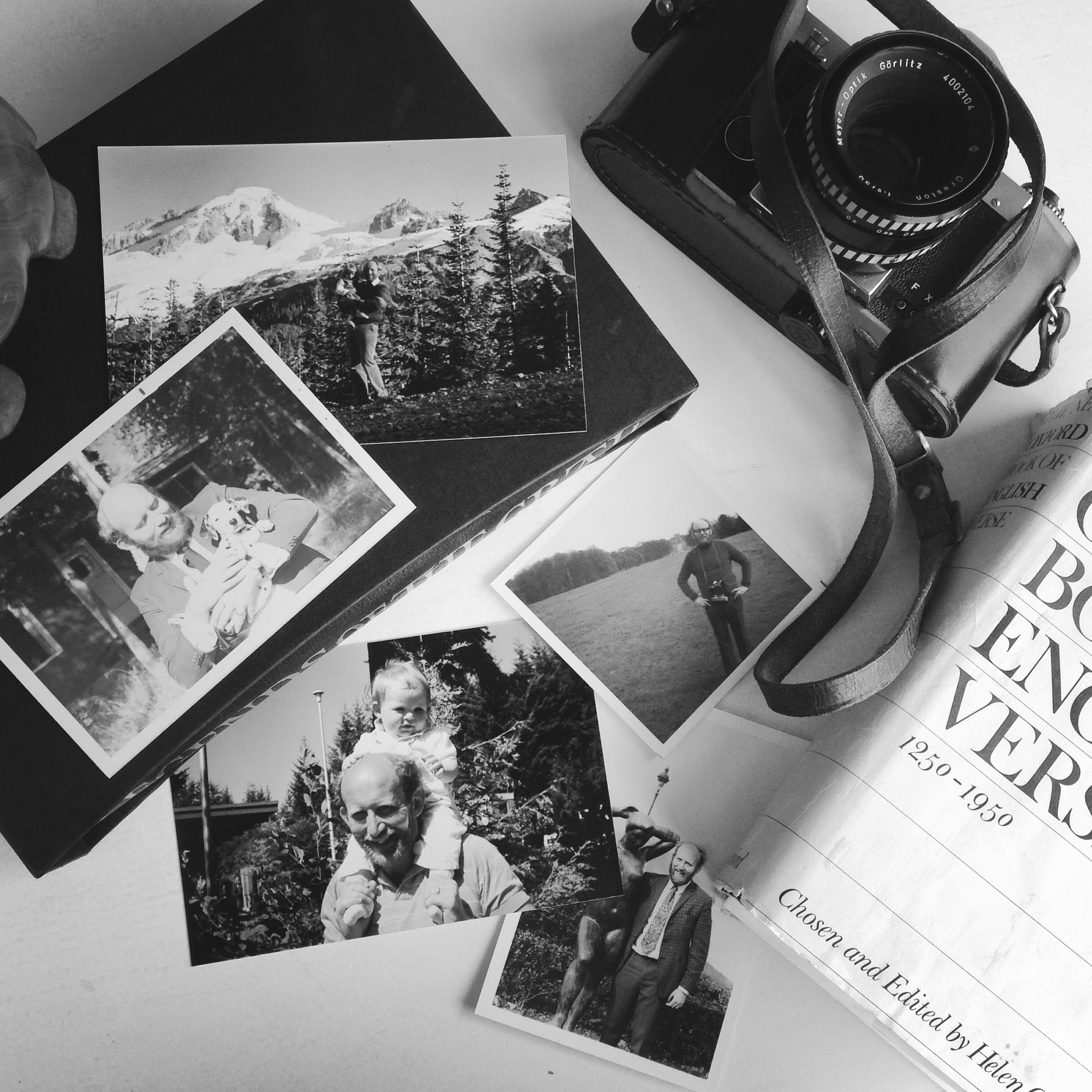
The music drifts in from the living room, a sweeping space at the front of the house with large windows that look out on to the property. This space belongs, unquestionably, to my dad. Outside its great windows is a bed of English roses. Beyond that, a large magnolia tree. And within the room, at its edge, there is a door which leads into a small study – a room that is imbued with my father. In it, there are stacks of letters and papers collected across his antique desk, little notes of hurried, illegible scribble. There are souvenirs from his travels and remnants of his younger self; there are wooden elephants and glass vases and old clocks from his parents; but most importantly, and positioned most prominently, is a wall of books. It is these books – this tapestry of colours, and stories, and knowledge – that are somehow tied to his essence. The tangible, magic pieces that serve as extensions of him.
As I descend the stairs, the music swells – a crescendo played off an old, oversized piece of equipment set up in the corner of the living room. I turn in and find my dad exactly as I expect to find him – in his armchair, surrounded by discarded newspapers and stacks of books, and him tucked away in the passage of one. He looks up at me and smiles.
This place, now, is gone. It no longer exists. The walls and floor and glass windows are still there. The house still stands – its walls repainted; its rooms refurbished. But this place is gone. It left with him.
Now, a lifetime away, I find myself in my own home. I look out the windows from my much smaller living room, stacked up high in a tall glass tower, at a city that pulses and moves around me instead of an idyllic pasture that lies quietly beyond me. Here, there are no beds of roses, there is no magnolia tree. And he isn’t here, either. He has never visited this place or any of the apartments and houses that preceded it. He has never known me in this city, or at this age, or in this different life. It all exists, now, without him. It exists as part of the life that followed after him. In what lay beyond that demarcation line – the life after dad. In this life, he doesn’t know I went on to graduate from university, to move cities, to do work that I hope he would be proud of. In this life, I can’t call him to talk, to ask him questions, to hear his voice. Here, there is no door through which I can enter to find him on the other side. There is no way for me to reach the place where he once sat listening to opera among his books.
That place no longer exists.
I was twenty when the call came – when the air went out, when the foundation cracked. Drawn home immediately by the news, I sat beside my dad at the dining room table – the place where we had sat together so many times before – as he explained how the latest exam, the one which had followed a litany of other tests, had finally revealed the cause behind his back pain. I was some previous version of myself then, some girl I would never be again. The girl I was before I learned of the dark layers that exist below the surface, deep within us. The girl I was before I discovered what it felt like to be hollowed-out. As we sat at the table that had held all the Sunday roast dinners, and Friday takeaways, and family gatherings that had come before, I couldn’t accept what he was telling me. The idea was untenable. It was somehow impossible to work my mind around it, and as I tried to – or tried not to – I found I could no longer take a full breath in. The breath instead sat shallow in my chest, the room for expansion suddenly reduced. I sat looking at him, his image blurred by tears I couldn’t control. As if speaking of some ethereal other with whom I could barter, I told him, “They can’t take you.” I pleaded, “Not you.”
They took him anyway.
My father was a huge, solid presence. Permanent, certain, immovable. Until he wasn’t. Until suddenly, and all at once, he was gone. And with him, so too went the place where we all existed together, the life we had before everything went rushing out. Yet it was somehow not immediately obvious that it would. The vast bleakness of his absence was all consuming, with no way of measuring all that had existed because of his presence. It wasn’t until the foundation crumbled and the familiar shoreline receded that the true depth of his absence was known. He was the centre of this place, the force that pulled it all in, that held it all together. And then he was gone, so down it went, and us with it. Pieces scattered everywhere.
There is now only a place that exists without him. A life that formed because he is gone.
This absence exists now in place of him. In the beginning, it was only a vacuous space where once his large presence had stood, but now it is filled with memories of him, and of all the things that remain because he was here. It is the part of me that thinks of him on crisp, sunny autumn days like the ones he used to love, or when I choose a new book to read, or whenever I hear song birds in the early morning and wonder to myself what type of birds they might be – the knowledge passed down from him in incomplete parts, not fully captured in time. I remember him when I catch myself holding my face in the funny way he used to, with fingers propped up to support it, usually when I’m tired and reading through my work. It is every time I hear him speak to me, when things are difficult, or beautiful, or just funny. It is the part of me that exists because he was my father, because of the values he instilled in me, because of the person he helped me to become. But also, the part of me that exists because he is gone, because I had to learn to stand without him. Because I had to learn to carry him with me instead.
The place where my father sat in his armchair, surrounded by books – the place where I was secure in the solidness of his presence – is gone. That place no longer exists. And yet, somehow, it does. I can call it up within me. I can return to that moment, to that life, in my mind. I can walk through the room, look out its large windows to see the bed of roses, the magnolia tree. I can return to his study, the place where I can once again touch the spine of all his books, safe in the knowledge that he had been the last to place them there. I can remember my dad looking up from his book at me, smiling.
 writing wallace
Leave a comment