Seven weeks ago, the world changed. What went from scattered news reports of a virus that seemed a world away suddenly arrived on our doorstep, exploding across our screens, and changing the way we live. On the Friday before it all sunk in, I was still stopping for a coffee on my way to work, casually sitting down in a restaurant for an evening meal. By the Monday, it had all changed, and I found myself packing up my things at the office – various files, a keyboard, my formidable little desk plant – into a box, and then into the car, to make the final drive home.
The pace of change that followed – news update after news update, endlessly refreshing twitter feeds, daily then hourly announcements – was overwhelming. Another case count, another foundation of normal life shuttered. I would stare at my phone from first waking until I went to sleep, and even then sometimes throughout the night. As our world shutdown around us, we wondered if our hospitals and streets would soon look like those countries hardest hit. No one could say for sure.
In my line of work, I found myself in acute crisis response, which I’d spend the next four or five weeks of my life consumed by. But even then, in the beginning, in the novel uncertainty of it all, I knew I was lucky. My work continues, I live in a happy home, in a safe part of the world. That gratitude hasn’t left me – I think about it often as I see local shops bordered up, businesses shuttered, lives lost. No matter how much my life has changed, I know I am fortunate to be where I am. To fill my fridge with food, to still be able to walk outside my home, to have my family safe. Many of us are, and when I talk about it with my family or friends, I can hear it resonate with them, the sobering knowledge of how different things could look.


We adapt. We create a new normal. We find a way to get on with life. It’s in our very human ability to survive, to bend to new circumstances, to find a way. People do this in sometimes funny ways – apparently a collective need to bake bread from scratch chief among them – but we manage to make it work. For myself that’s meant setting up a proper home office to create a demarcation line between the workday and the rest of my life – something I had never done before, despite having worked from home frequently in the past, which usually involved moving the laptop from room to room throughout the day. I brighten the space with cheap tulips I buy during my now surreal weekly excursions to the grocery store. In the time before, I would ordinarily pop in to the grocery several times throughout the week, picking up a necessary ingredient or a few desired items. Now there are long, socially distanced queues outside the store to control capacity and inside, tape markings on the floor to show you how far to stay apart. There are plastic shields on check-out counters and hand sanitizer stations. And often, especially in the beginning, empty shelves where once staple household items had been. But despite this new, weird normal, there are still cut flowers, and fresh meat and produce, and well-functioning supply chains. There is expensive cheese and artisan baked bread. Life, still, continues, in whatever new way it has to.
After trips to the grocery store, we bring the bags of supplies back into the house, having sprayed ourselves down with disinfectant first in the store and then scrubbing our hands at home until the skin begins to dry and crack. Even though we’ve brought the outside world in with us, home still feels like a safe place. I over clean it now, too. All day putting things back in their place, clearing the space. I unload and reload the dishwasher, and unload it again. I somehow still do endless amounts of laundry. I water the plants. I run the diffuser and light candles at night. All in an attempt to at least control the feel, the security, of my home.
And just like that, all these activities become normal, a weird process of familiarisation with what was at first overwhelming and novel, and now, just is.
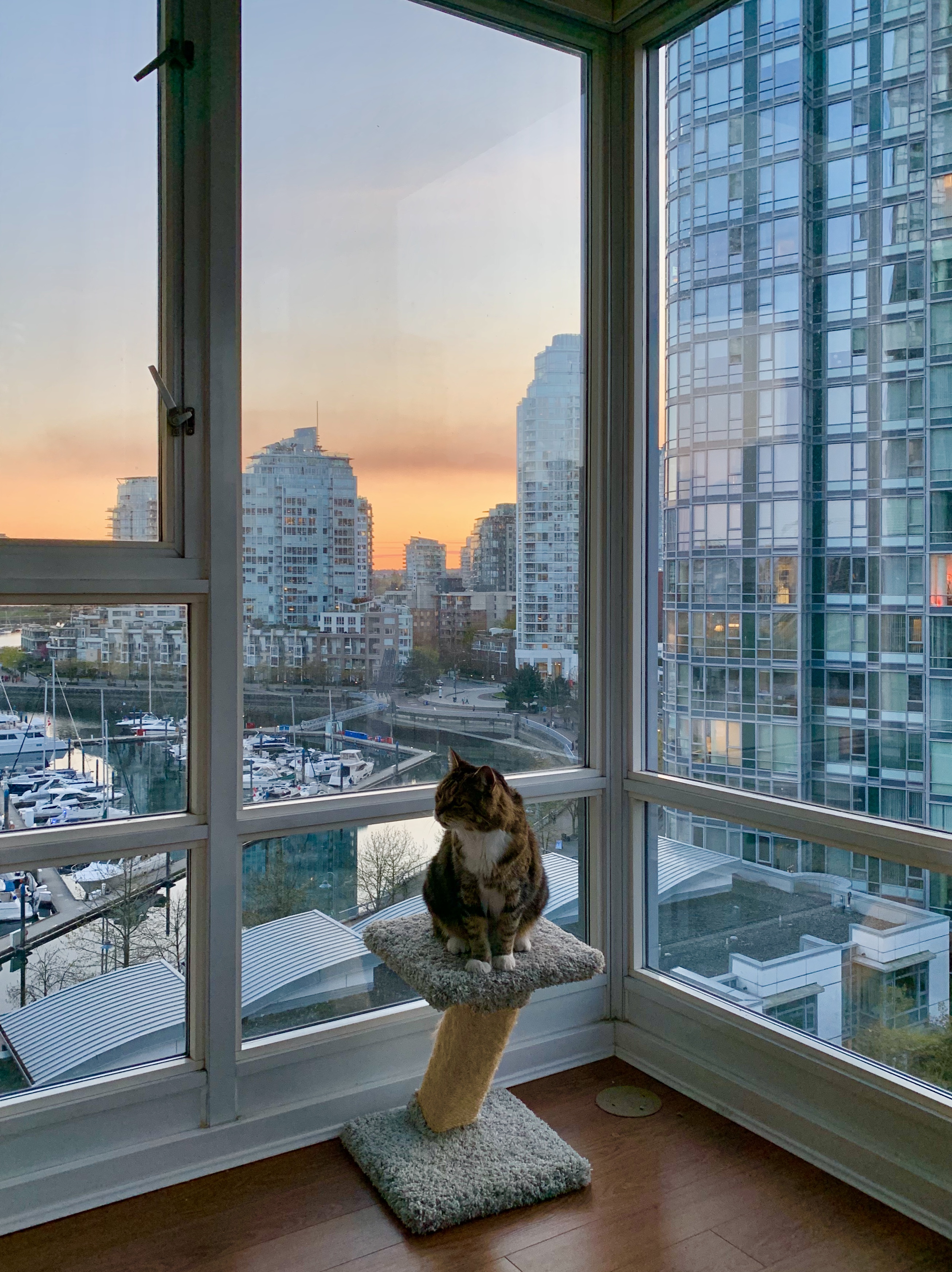
As I moved beyond the crisis point in my work, I began to stretch out in this new way of living. I developed new routines. From the plethora of fitness classes that have moved online, I’ve found a few that I can do from the corner of my living room and without equipment (with the exception of substituting soup cans for free weights). I discovered that I don’t need to edge out 90 minutes in my day to go to the yoga studio and can instead lay down my mat for a sequence anytime. I watch for non-peak times to walk out onto the seawall, though even then it’s still busy, and the new dance of avoiding others carries on. I’ve also built back my meditation practice now that mornings, usually overrun by getting ready to get out the door, can be replaced with sitting down on the floor and focusing on the breath. I’ve opened up new books. I’ve put down the phone and the endless, mindless scrolling of social media (not always successfully). There’s also been moments of boredom, and of comfort. Of a Netflix binge on the couch, or enjoying a grilled cheese for lunch (a real accomplishment given I’m using bread made from quinoa and cheese made from cashews). And there are moments of feeling frustrated, and confined, and exhausted. But we adapt. It’s what we’ve learned to do.
In the onslaught of information that came barrelling through, especially in those early weeks, was a repeated suggestion that quarantine has resulted in vast amounts of free time and the heavy implication that we must be productive with it. I was so busy in those weeks, from responding to demanding work to navigating through an avalanche of information, I found the suggestion ridiculous. Who exactly has more time? But even as the pace of the crisis slowed, and finally I too saw these empty blocks of time I hadn’t seen before, I still found the suggestion that we must utilize this time productively, above all else, to be misguided. The articles, and blogs, and well-meaning friends suggest you should use this time to accomplish a goal, to learn a new skill or start a new project. But I think this expectation is out of place – it might work for some, but certainly not for all. If you happen to find yourself with extra time to take on a project, and most importantly if you feel you have the capacity to tackle it, then go for it – perhaps it will even help deliver something constructive or positive from this experience (I mean, hey, I did write this blog). But the truth is each of our experiences of this pandemic is different, depending on where we live in the world, on the type of work we do, on what devastation we might have to face. It won’t be possible for all of us to be productive in this time, or to find silver linings. For some, it will just be about surviving.
The opportunity then, I think, is in what happens when we return.
In Canada, we are starting to see an easing of restrictions, a plan for how we will move forward from here, in a continued world of uncertainty. In our new normal. This shutdown has stopped us all, paused whatever was our normal way of working, or living, of being. We must now consider how we will restart. And I think that’s where the opportunity lies.
Whatever this time has meant for you, whatever your experience has been, I’d wager to guess it’s given you some insight into your life. It may have led you to consider the things you miss, and the things you don’t. It’s allowed us all to take a step back and evaluate our normal ways of doing things from this strange, suspended state we’re in. And I think it’s given us this rare opportunity to be mindful about the type of life – the new normal or otherwise – that we want to return back to. To think about what wasn’t working for us, what we might want to do differently, what we might want to change. To think about how we want to use that elusive block of extra time, and how we might be more intentional in how we shape it. Because now we know there is another way. So why not try it?
 writing wallace
Leave a comment